Prescription eyewear presents a practical challenge on the slopes: the skier needs clear vision without sacrificing coverage, stability, or protection from changing weather. For many users, simply placing regular glasses beneath a goggle can create pressure, ventilation, and fit concerns. At YIJIA Optical, we view optical adaptability as a design question that involves the relationship between prescription eyewear, lens geometry, frame dimensions, and the wearer's overall equipment setup.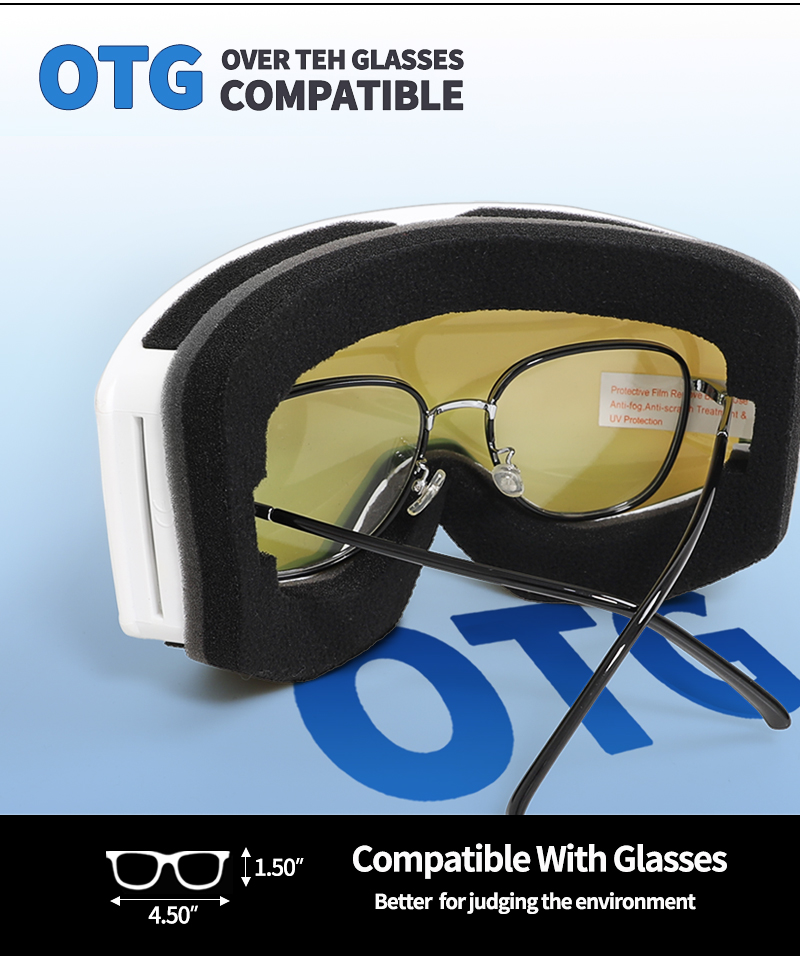
Prescription glasses are designed around the wearer's specific visual correction, while snow goggles are designed primarily to protect the eyes and provide a broad field of view. Combining the two creates an additional layer of optical and physical considerations. The distance between the prescription lens and goggle lens, for example, can affect perceived visual geometry and available interior space.
Frame volume also deserves attention. A goggle with limited internal clearance may press against prescription frames, particularly when the wearer moves or adjusts the strap. That pressure can become uncomfortable during extended sessions and may interfere with the position of either optical system.
For anti scratch Ski goggles, surface durability is another consideration because scratches can affect light transmission and visual quality over time. However, scratch resistance should be considered alongside fit, lens construction, and storage practices rather than treated as a substitute for sound optical design.
OTG, or over-the-glasses, construction gives prescription wearers additional interior clearance so that a goggle can fit over ordinary eyewear. The design typically requires changes to the frame volume and internal geometry, with enough room around the temples and bridge to accommodate the glasses.
That extra space must be carefully balanced. Excessive internal volume can affect how the goggle sits against the face, while insufficient clearance may cause contact between the prescription frames and the goggle lens. Foam placement and strap positioning also influence whether the two pieces of eyewear remain stable together.
A practical fit assessment should therefore consider the prescription frame itself rather than assuming that every pair of glasses has the same dimensions.
The optical system becomes more complex when prescription lenses are positioned behind the goggle lens. Reflections, condensation, curvature, and spacing can all influence the visual experience. A well-designed snow goggle should provide enough interior room for prescription glasses while maintaining appropriate protection and visibility.
The YH682 provides a useful example. Its full-frame construction uses a cylindrical double-lens system with OTG compatibility, designed to fit over prescription glasses. The model uses an anti-fog lens with UV400 protection, while its available lens colors include ice blue, blue, purple, silver, gray, and black, with customization available.
For ski goggles for kids, optical compatibility can require even more attention because children's prescription frames vary widely in size and shape. A goggle intended for younger users needs to account for facial dimensions as well as the physical space occupied by their eyewear.
The central consideration is not simply whether glasses can fit underneath, but whether both optical components remain comfortably positioned during movement.
A snow goggle serves several functions simultaneously. It shields the eyes from wind, snow, and intense reflected light while maintaining a usable field of vision. Adding prescription eyewear should not disrupt these basic functions, which means frame shape and facial contact remain important even in an OTG design.
Lens protection also matters during active outdoor use. An anti scratch Ski goggles configuration can help the lens surface remain more resistant to everyday abrasion, but users still need appropriate cleaning and storage practices. Snow, dust, and incorrect wiping methods can damage optical surfaces regardless of the original lens specification.
The most useful approach is to assess optical adaptability as part of the complete wearing system rather than as a separate feature.
Not every prescription wearer has the same requirements. Some use narrow rectangular frames, others wear larger fashion-oriented glasses, while certain users may need additional space around the bridge or temples. Age introduces another variable because facial proportions change significantly throughout childhood and adolescence.
Products intended as Ski goggles for kids therefore need age-appropriate frame dimensions and sufficient flexibility around fit. The goal is not simply to make a smaller adult goggle; designers need to consider how the frame interacts with smaller facial features, helmets, prescription glasses, and movement.
Our team at YIJIA Optical approaches these requirements through sports-eyewear development and OEM/ODM production. Considering the intended wearer early in the development process allows frame geometry, lens configuration, and customization requirements to be discussed as connected decisions rather than isolated specifications.
That user-centered perspective becomes particularly valuable when a product is intended for a defined market segment.
Prescription compatibility illustrates how snow-goggle design involves more than lens selection. Interior clearance, cylindrical or other lens geometry, frame dimensions, foam placement, ventilation, and the shape of prescription eyewear can all affect the final fit. A thoughtfully developed OTG configuration gives users another practical option without requiring them to abandon their everyday visual correction.
At YIJIA Optical, we consider these relationships during sports-eyewear development, and the YH682 demonstrates how a full-frame cylindrical double-lens structure can incorporate OTG compatibility alongside anti-fog and UV400 protection. For brands exploring Ski goggles for kids or other specialized eyewear categories, understanding the physical and optical needs of the intended wearer provides a stronger foundation for product development than relying on a single feature.