Winter sports expose eyewear to conditions that ordinary daily-use glasses rarely encounter. Sudden impacts, low temperatures, snow particles, and rapid movement place demands on both the lens and surrounding frame. For anti-fog Ski goggles, optical clarity and impact resistance both depend on appropriate lens material and overall construction. At YIJIA Optical, we consider lens material as one part of a broader protective system, where impact resistance, optical performance, weight, and frame compatibility need to work together.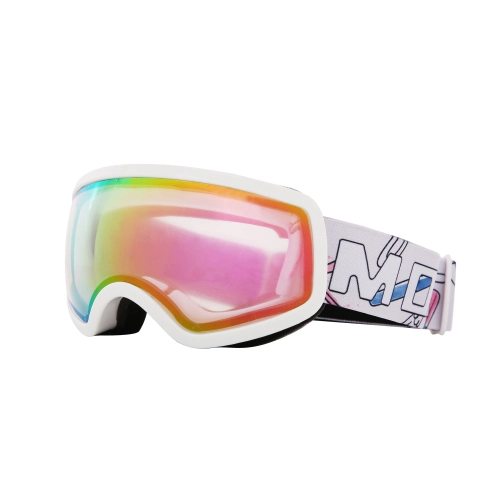
Polycarbonate is widely used in protective eyewear because its material characteristics make it suitable for applications where impact resistance is important. Compared with conventional glass, it is much lighter and less prone to shattering into sharp fragments, which makes it practical for active outdoor equipment.
The material also offers useful design flexibility. Injection molding allows manufacturers to form lenses into controlled geometries, making it possible to develop curved surfaces suited to wide-field sports goggles. Lens curvature can influence peripheral vision and the overall relationship between the optical component and the frame.
For high performance Ski goggles, these material properties provide a useful foundation, although the final performance still depends on lens thickness, geometry, processing, mounting, and the surrounding frame.
Injection molding forms heated polymer material within a precision mold to achieve a controlled lens geometry. Once the material cools and stabilizes, the resulting component follows the geometry established by the tooling. In sports eyewear, this method supports repeatable production of curved lens shapes and complex product configurations.
Tool design becomes especially important because even small variations in geometry can influence optical quality. Mold precision, material conditions, cooling behavior, and processing parameters all need to be controlled during production. A lens that has suitable impact characteristics still requires appropriate manufacturing conditions to achieve the intended optical form.
At YIJIA Optical, we consider these manufacturing variables during OEM and ODM development because lens material selection cannot be separated from how the component will ultimately be produced.
The manufacturing method is therefore part of the engineering equation rather than merely a production-stage decision.
A strong lens does not work independently. During an impact, forces can travel through the lens, frame, attachment points, and facial interface. The way these components interact influences how the goggle responds to sudden external forces.
Frame flexibility can also affect the overall system. A rigid structure and a flexible polymer frame may distribute or respond to force differently, while foam provides another interface between the product and the wearer. Testing the finished assembly therefore gives more useful information than evaluating the raw lens material alone.
For anti-fog Ski goggles, the same principle applies to moisture management: lens properties, frame geometry, foam, and ventilation interact rather than operating as independent features.
Impact resistance is only one requirement for winter eyewear. A lens also needs to provide useful visual information across changing outdoor conditions. Snow can produce intense reflected light, while cloud cover and terrain shadows can alter how surface details appear.
Polycarbonate lenses can be produced in different optical configurations and treatments according to the intended application. UV protection, anti-fog characteristics, color, and other surface or optical features may be incorporated depending on the product specification. Each addition needs to remain compatible with the underlying lens and its manufacturing process.
For high performance Ski goggles, the important question is therefore not simply whether polycarbonate lens is impact resistant. Developers should consider how the optical, protective, and environmental requirements interact under realistic skiing conditions.
A technically suitable material becomes more useful when its properties align with the complete product objective.
Material selection also influences how a goggle feels during prolonged use. A lighter lens can reduce the overall mass of the product, while frame geometry and foam determine how that weight is distributed around the face. Small differences may become more noticeable during long skiing sessions or other high-movement activities.
Fit introduces another layer of engineering. Prescription eyewear, helmets, face coverings, and different facial proportions can change the available interior space. OTG compatibility, for example, requires sufficient clearance without creating unnecessary bulk around the face.
Our team at YIJIA Optical considers these practical factors during sports-eyewear development so that material decisions can be evaluated alongside frame construction and user requirements rather than in isolation.
Comfort and protection are not competing ideas when the complete system has been designed around the way the product will actually be worn.
Laboratory impact testing provides valuable technical information, but product development should also examine optical consistency, fit, environmental exposure, and repeated handling. Winter eyewear can encounter temperature changes, snow, moisture, abrasion, and accidental contact with equipment throughout its service life.
Quality assessment should therefore cover the finished goggle rather than relying exclusively on raw material data. Lens molding, surface treatment, assembly, strap attachment, frame geometry, and foam placement can all affect the final product. A specification sheet is useful, but physical samples remain important for evaluating how those components behave together.
For brands developing high performance Ski goggles, this broader evaluation can help identify whether a lens material actually suits the intended use, production method, and customer expectations.
Good material selection starts with the application and ends with verification of the finished product.
Polycarbonate offers a practical combination of low weight, impact resistance, and molding flexibility for winter sports eyewear, but those characteristics do not exist in isolation. Injection-molded geometry, optical design, frame construction, foam, fit, and environmental conditions all influence the finished goggle. Understanding these relationships gives product developers a more realistic basis for assessing protective eyewear.
At YIJIA Optical, we apply this system-oriented perspective to sports-eyewear development, including models that combine a flexible TPU frame with high-density foam options, an elastic anti-slip strap, a soft nose guard, and OTG compatibility. For brands evaluating anti-fog Ski goggles, material selection is most useful when it supports the wider requirements of impact protection, optical clarity, comfort, and practical winter use.

